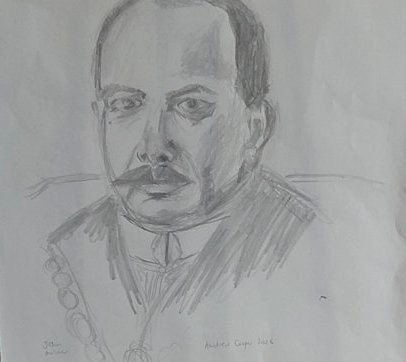
Who was John Archer?
His life, told through the records that survive. Each one is shown with where it is kept.
John Richard Archer was born in Liverpool on 8 June 1863, the son of Richard Archer, a ship's steward from Barbados, and Mary Teresa Burns, from Ireland. Two years before he was born the census found the family living in a cellar in Blake Street, the poorest kind of housing in the city. By seventeen John was an apprentice photographer. He would be a singer, a photographer again, a councillor, a mayor and a Labour leader before he died.
Read his full story
By 1901 he and his wife Margaret, who was born in Halifax, Nova Scotia, were living at 55 Brynmaer Road in Battersea, a short walk from Battersea Park. He described himself to the census taker as a professional singer. Within a few years he had a photographer's shop on Battersea Park Road. In 1900 he went to the Pan-African Conference at Westminster Town Hall, and in 1911 the census he filled in himself lists a visitor in the house: Jane Rose Roberts, aged 91, widow of the first President of Liberia.
Battersea voters elected him to the borough council in 1906. He lost his seat in 1909 and won it back in 1912. On 10 November 1913 the councillors and aldermen met at Battersea Town Hall, the building that is now Battersea Arts Centre, and chose him as mayor by 30 votes to 29. He was the first Black mayor in London. The next morning the newspapers across the country carried his speech: "I am a man of colour."
He stayed in public life for the rest of his life. He led a deputation to Liverpool in 1919 after attacks on Black seamen, was carried out of the council chamber with the other Labour members in 1923, and was Labour deputy leader when he died on 14 July 1932. Children from the local church schools sang at his funeral.
The records
Three documents from his life: the register that records his birth, the census that shows him learning his trade, and the minutes of the vote that made him mayor.
The portraits
Pupils at St Mary's imagined Archer's life in watercolour: at home, in his studio, walking down Battersea Park Road. Pupils at Sacred Heart painted him in pastel as mayor, in his chair and chain, and wrote what they would do if they were Mayor of Battersea. Swipe through each school's paintings and select any portrait to read the artist's own words.
St Mary's RC Primary School
Year 5 and Year 6 · watercolour · paintings
Sacred Heart RC Primary School
Year 5 · pastel and collage · paintings
If I were Mayor of Battersea
In 1913 Archer told the council chamber what he stood for. More than a hundred years later, Sacred Heart pupils wrote their own pledges.
More from the classes
Mia's second piece, drawn over the newspaper report of Archer's speech, and three A4 pieces made in class from his mayoral photograph.
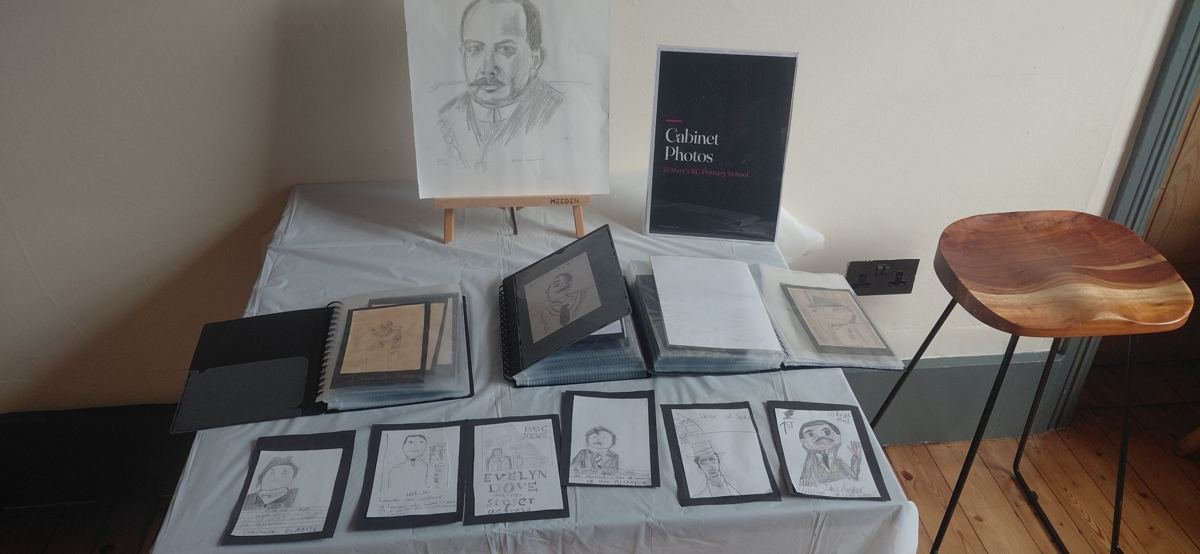
Cabinet cards
Other classes at both schools made cabinet cards of their own, each one a Black Briton of Archer's time. Swipe through each set and tap a card to see it large, with the back of the card where there is one.
What a cabinet card was
From the 1870s to the First World War, a visit to a photographer's studio ended with a cabinet card: a photograph about the size of a postcard, pasted onto stiff card. The photographer printed his name and address along the bottom of the mount, and often more details on the back. People kept them in albums and gave them to friends. A studio like Archer's on Battersea Park Road would have turned out hundreds.
Why they are brown
The photographs were printed on paper coated with silver salts, then toned in a bath of sepia. The sepia turned the picture a warm brown and helped it last, which is why old studio portraits have that colour. To get the same look, some pupils drew their sitters in pencil on brown card, so the drawing has the tint of an old print from the start. Others stained white paper by hand, washing colour over it and letting it dry in patches, so the finished portrait looks faded and foxed with age. Then they mounted it on black card, wrote the studio's name on the front and the sitter's story on the back, the way a real card would have been made.
Who the pupils chose, in their own words
I chose James Peters, a rugby player, the first Black man to play for England.Petros
I picked Dr Harold Moody because he was a doctor.Nathan
Henry Sylvester Williams, lawyer and campaigner. A lawyer who helped organise the first Pan-African conference in London.Reggie, 6G
Lilian Bader was a servicewoman. She was born in Liverpool in 1918 and died in 2015. She later became one of the first Black women to serve in Britain's armed forces.Amber, 6G
Sarah Forbes Bonetta. Born in Africa, she lived in Britain and became Queen Victoria's goddaughter.Shanie, 6G
Peter Jackson. An outstanding Black boxer of the Victorian period who fought and performed in Britain.Nick, 6G
S. J. Celestine Edwards. A writer and lecturer who became a prominent Black voice in Victorian Britain.Nethan
Dr John Alcindor was a doctor, then a campaigner.Ernest, 3R
Sarah Forbes Bonetta. Born in West Africa, she lived with Queen Victoria's household.Mariam
The cards
At Battersea Arts Centre
Families, pupils and visitors in the Waiting Room, 8th – 11th October 2026.